
John Martin Greiner
This article was published in the Historic Marion County/ Ocala Preservation Society newsletter in Winter 2009 that I wrote documenting my journey in researching my Fifth Great-Grandfather John Martin Greiner.
My Historical Journey
by Kimberly Rayborn
Several years ago, I came across a Revolutionary War pension request on behalf of my Fifth Great-Grandfather John Martin Greiner that was filed by his son Jonathan in 1846. I have read many documents before, but at the end of the first page, the words really began to speak to me of the struggles of his life as it read “…he fought at the Battle of Eutaw Springs under Gen. Green…received during the war, a severe wound in one of his legs…during the war re-sided on the Savannah River in Screven County, State of Georgia, where royalist in course of Battlefield of Eutaw Springs the war, deprived him of all he possessed, drove away and killed and appropriated all his cattle, his principal property, robbed him and his family of the necessary means of substance and burnt down all his houses, so that declarant’s father and family were cast upon the world without house or homes suffering every hardship and privation and misery that poverty and war could inflict.” This inspired me to find all I could on this grandfather.
My Fifth Great-Grandfather John Martin Greiner and his family were part of a religious group of German-speaking Lutherans called Salzburgers. The Catholic Church in 1731 issued the Edict of Expulsion because the Protestants of the Province of Salzburg in Austria continued to follow the teachings of Martin Luther. This Greiner family came across the Atlantic Ocean and eventually settled in Ebenezer, Georgia near Savannah. The Salzburgers were efficient in organizing the first church and orphanage in Georgia; and built the first grist mill, rice mill, sawmill, and silk business in the state of Georgia.
Life in Georgia in colonial times was difficult between the harsh living conditions in an unknown land and Indian raids. Many of the settlers were subsistence farmers who had to provide for themselves what was necessary for survival during a time when the only source of food was from their own initiative. Savannah was the only town of importance, and at the time of the Revolution. It was still a wooden village, and the roads were Indian trails.
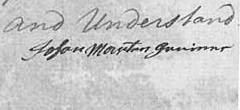
In the beginning of my research, I found a brief description of one of my grandfather’s land grants. The paper stated: “Granted on June 7, 1768. 250 acres bounded on the east by George Streigler and Michael Beaner, southeast by Nicholas Fisher and northeast by John Tanner.” (This is where he lived before the Revolutionary War.) Later I found where he was a witness for Nicholas Fisher’s and Michael Beaner’s probate records. For his dying neighbor Michael Beaner, my Grandfather Greiner wrote Beaner’s last Will and Testament in German. This is recorded in later legal entries and the German written probate record still survives. His signature is recorded several times as a witness on these documents. I was also fortunate to find several payment receipts for his war service as a horseman in the militia in the South Carolina Archives.
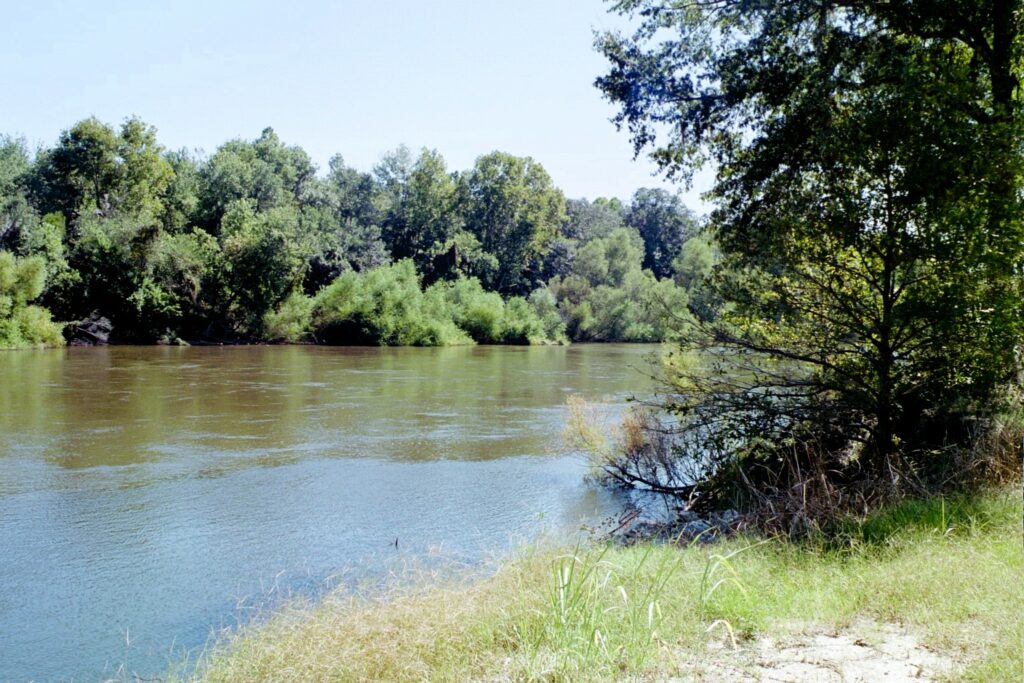
In another land grant of John Martin Greiner, dated 1786, it described in exact detail how a ‘Briar Creek’ forked into the Savannah River. With much determination, I studied maps of the river to find the location. We had to travel to River Road which was the main route of travel from Savannah to Georgia’s western frontier. Originally, River Road was an Indian path and was eventually opened up by General Oglethorpe for carriage and wagon travel. As I traveled on River Road in September 2007, part was paved road, and other parts were still dirt. The area surrounding this road to this day is almost like time has stood still. River Road is still an isolated area. There were so many unmarked dirt roads leading to the Savannah River that our only hope was to find a specific old cemetery that was on the same road according to the map. We were fortunate to pull up at the right house where the people knew where the cemetery was located. We traveled several miles toward the Savannah River on this dirt bumpy path to arrive to view the fork in the Savannah River listed on the land grant. After arriving and seeing this place, I was overjoyed that I had found the land my Grandfather Greiner had lived on after the Revolutionary War.
After this marvelous find, we headed toward Eutawville, South Carolina to the Battlefield of Eutaw Springs where John Martin Greiner had fought in the Revolutionary War. Sadly, today a majority of the battlefield and old plantation homes lie under Lake Marion and Lake Moultrie. Among the homes under water, is Pond Bluff, home of Revolutionary War hero Francis Marion, who was called the Swamp Fox, for which Marion County, Florida is named after.
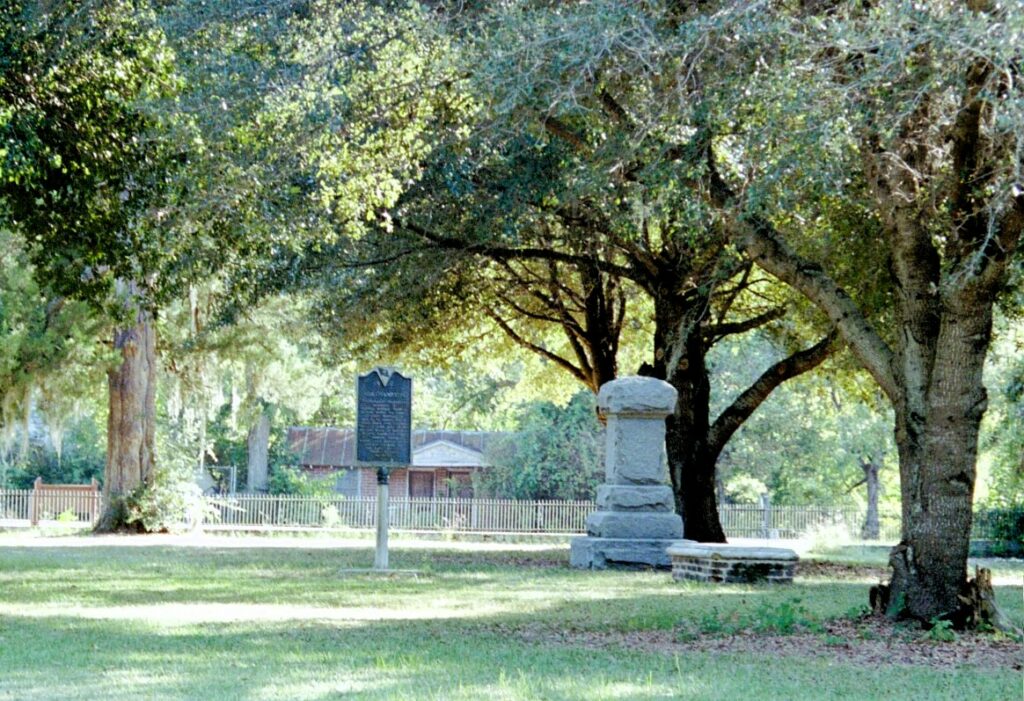
Battle of Eutaw Springs in Eutawville, South Carolina
October 2007
The Battle of Eutaw Springs was the last major battle in South Carolina during the Revolutionary War. The battle between the Americans and British was a draw. It was one of the factors which made the British leave from the South, which prepared the way for the siege of Yorktown. According to a firsthand account, many soldiers were buried where they fell on the Eutaw Springs Battlefield; therefore, the battlefield is a cemetery itself.
According to my grandfather’s son Jonathan, John Martin Greiner died in 1807. Unfortunately, we do not know where he died or where he is buried. After years of research, I finally found and visited where my grandfather had lived and where he fought in the Revolutionary War.
As I looked onto the Battlefield of Eutaw Springs, I said a quiet ‘thank you’ to my grandfather and all the others that had fought there for our independence. My Grandfather Greiner will be remembered for his sacrifice because of my research being published. What greater gift could I give to him and to his memory.